How To Get Rid Of Negative Thinking?

Let’s face it. Even with good intentions, we all think negatively sometimes. Beating yourself up when you think in a negative way? It’s not going to bring you any positive outcome. So, what’s the point?

The key thing is to find ways of transforming the thinking pattern so that it doesn’t eat up the rest of your day. But how?

In September last year, I happened to see Dr Karl Kruszelnicki at Dymocks city bookstore on a book-signing event, for his latest book entitled: Karl, The Universe and Everything.

I’ve always been drawn by his wit and in-depth knowledge of many things – good, bad, beautiful and ugly. Sometimes even stuff you feel shy, embarrassed or ashamed to talk about, he writes about it.

Out of curiosity, I went to pick up one copy and had a quick browse while there. One chapter called Earworm really struck me.

I was fascinated by the well-researched information, particularly some good tips on how to get rid of earworms. To my surprise, chewing gum is said to be the most effective way to date.

If you don’t know what earworm means, according to Cambridge Dictionary, it means a song that you keep hearing in your head.

In my previous experience, an annoying song (I won’t name it here) was playing in my head again and again. It was spinning like a broken record, just driving me insane. It happened while I was out and about around a beach. All up, it lasted two hours.

How did I stop it eventually? As soon as I got home, I turned on my stereo and played one of my favourite songs on repeat. It was an instant cure! A gentle and effective way to kill an earworm, with no side effects! Of course, that song I played didn’t become another earworm. Even if it had, it wouldn’t have bothered me.

Well, that’s not the end of the story. To satisfy my inquiring mind, I wanted to know more. I wanted to find out if there’s a correlation between negative thoughts and earworms.

What if we start treating negative thoughts like earworms? Try chewing gum? Will playing my favourite 80’s songs help? Interesting huh? Well, that’ll be my next project. Watch this space.

For now, I’m going to leave you with something to chew on here. Till next time, stay tuned!

Ted’s Quote 14

Failure shouldn’t be a dirty word, but we treat it like one.

If success is a commodity, then failure is the currency. After crunching the numbers, I realized you simply can’t trade success without failure.

In the process, no money laundry is required… Ted Tsai

It’s Give And Take, Not Take And Give

Undeniably, many of us want to be treated like a special person. The question is what does it take to be one? Or I should really say what do you have to give to be one?

Not boasting here but believe it or not, I often get VIP treatment from retail stores. Things like freebies, samples and discounted items. What’s the secret?

There’s a bit psychology behind it. It’s about building a close relationship with the sales person you are dealing with.

Sounds a little too vague or too broad? In fact, it really all boils down to making the other person feel as special as you want yourself to be.

The starting point is to go out of your way to create a memorable experience. For me, it’s:

  • Being present
  • Showing interest in the person first
  • Showing desire for their products

Say I’m in a shop and have been hovering around a merchandise for an extended period. This generally sends out a strong message to the shop that I want to buy something from them.

In turn, it’s an open opportunity for them to approach me and remember my face as a customer. If we interact and connect well on a personal level and I really like the goods, then I may take it straight away without making a fuss.

Later If I have a chance to go back to the shop on a second or third visit, I’ll look for the same sales person who served me in the first place, just to say hello and make small talk. My typical opening line is: Hey, do you remember me? I was here last time. I bought this and that…

As a returning customer, it’s amazing how people reward you for your continuous support especially if you have the big buying power. They may give you a complimentary gift in return. Of course, if you ask nicely, they’ll also be happy to offer you a special discount or throw in an extra for free. This has worked for me 9 out of 10 times. But buyer beware! Be prepared to walk away when it doesn’t work for you. There’re plenty more fish in the sea.

If I can sum up in just a few words:

  • Building the loyalty before you establish your royalty.

Lastly, never take their kindness or generosity for granted. The moment you stop showing appreciation, it’s also the time you give your power away and potentially lose the VIP status. After all, in a particular order, it’s a matter of give and take, not take and give…

Ted’s Quote 13

In the digital age we live in, it’s important to be emotionally intelligent, both in person and online.

Remember, if someone pushes your buttons, just stay calm, then gently and firmly push one of these buttons back – OFF or DELETE… Ted Tsai

Stop, Look And Listen To The Music

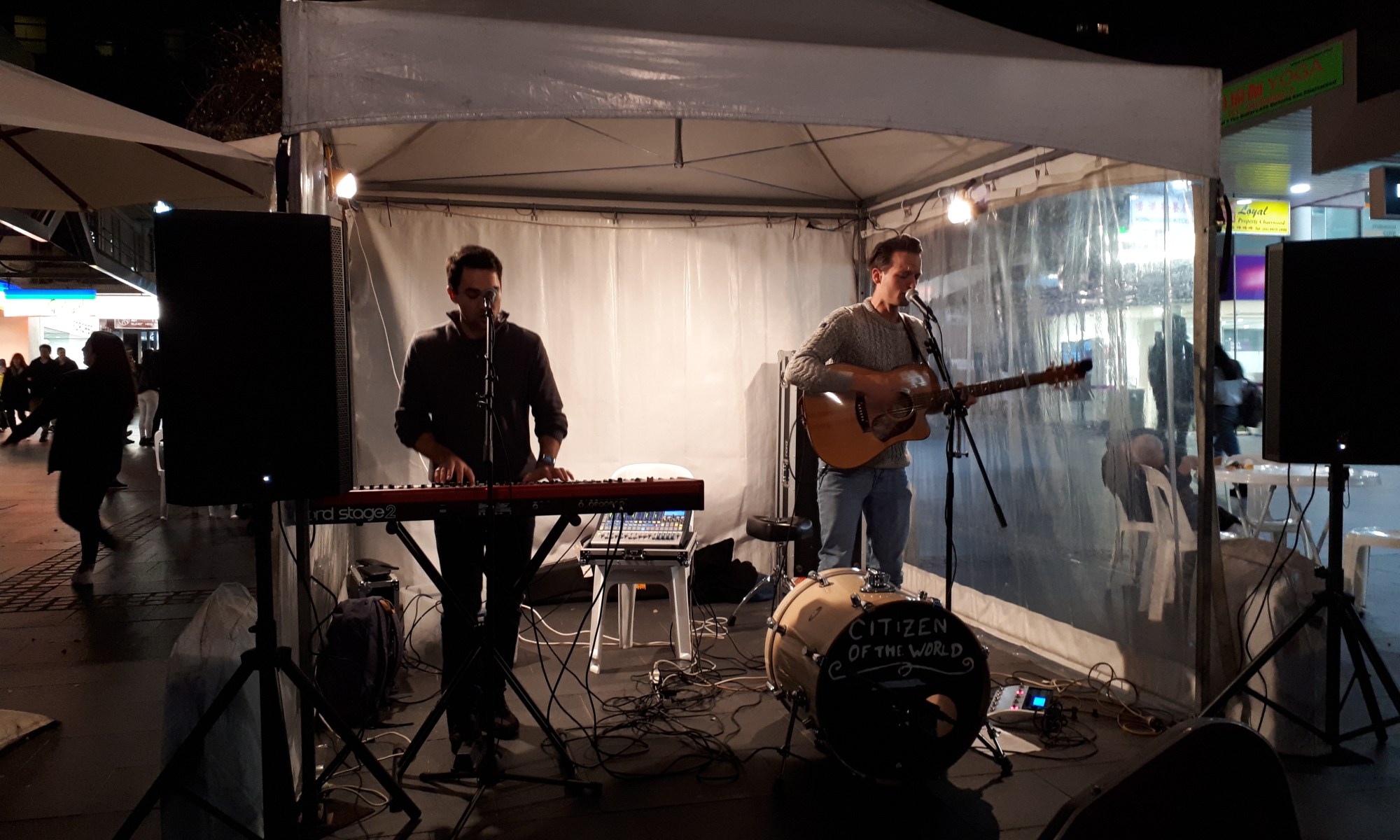
Chatswood Mall Market is a hectic place. There’s a good variety of market stalls to please all sorts of shoppers including food from around the world – Greek, Spanish, Turkish, Japanese, Chinese, Malaysian, Taiwanese, you name it. It also features a live musical entertainment in a wide range of genre every week.

“Citizen of The World” was the band busking one Friday evening some time ago. In fact, it was the second time I saw them there. Even though I was much drawn by their tune the very first time, I didn’t stay to watch them play. It was all because I was in a mad rush to do my grocery shopping.

It took me the second time to stop and immerse myself in their music. I found myself gravitating towards the energy and the emotions flowing through the band members. It felt as if the lead singer was singing for me especially when he was interpreting a very powerful ballad or a sad song as he called it. I could tell he must’ve sung it from his heart. It was very moving.

Captivated by their musical style, I decided to own it on the spot. Counted to 3, I took a few quick steps towards the centre stage, put a ten dollar note inside an open guitar case that already had some loose coins and notes lying around, then grabbed a copy of their latest EPs “Memories In My Head” from a box. For some reason, I was a bit nervous to get so close to them but I felt like they needed my support, so I just went for it.

Later that night I found the band’s Facebook page and decided to write them a text message to say how much I loved their gig. To my surprise, a couple of hours later the band members responded with thanks and some really kind words. One said it makes his day. The truth is they made my day as much as I made theirs.

I guess any one of us can be just another face in the crowd, but the thing is we all the power to make a difference to someone’s day even in a smallest fashion. I’d love to see the band make a name for themselves one day and continue to touch people through their songs.

Next time, if you happen to see an artist or a band playing a gig you like, why not stop, look and listen to the music. It’ll mean a lot to them…

PS: It gave me a great pleasure when they shared this post on their Facebook page.

Take Small Actions

When are you due for another dentist visit? Do you dread the day till it’s over? If you do, I feel for you.

In my case, I was almost 6 months overdue for the next dental check-up. I let it slip my mind for a long time. But hey I had good excuses. I led a busy life. I didn’t have time blah blah blah.

One morning out of blue, I decided it’s time to get off my back side and act, so I called my dentist.

It took less than two minutes to make the appointment and as soon as it was booked, the anxious feeling went away.

What’s easier, the day I had it done, it wasn’t as painful as I’d anticipated. In fact, the whole experience was so relaxing that I almost dozed off on the dental chair!

Now looking back, I’ve come up with two questions.

Question One: Why did I put it off for months and months?

Not surprisingly, my procrastination was largely to do with fears:

  • Fear of the unknown
  • Fear of what if’s
  • Fear of all the ridiculous, unfounded worst scenarios playing in my head.

The next question: What prompted me to make that phone call at last? The quick answer is: Pressure.

I was not self-motivated enough till the pressure started to mount. Where did the pressure come from? The deadline! As they say, if you don’t use it, you lose it.

This experience has left me wondering if there’re any useful tools that can help reduce the likelihood of inaction or even better increase the chances of action.

In the process, I’ve found one technique to be effective:

  • Breaking down large things into small things and small increments.

As the year draws to a close, most of us will probably think of making new year’s resolutions. The intention is good but sometimes our yearly goals can be too big, too overwhelming and too scary. The challenge for me has always been how to make them stick.

Knowing what I’m like, what I’m good at and not good at, I’ll be trialing something new this time, I call it my new day’s resolutions as opposed to new year’s resolutions. It means taking small steps towards small goals in relatively shorter time frames. It’s about creating many small wins. After all, a small win is still a win…

What Does It Take To Be A Leader

I’ve been on the path to self-improvement for some months. As a strong advocate for life-long learning, I’ve found the process to be an eye-opener.

Each time I went exploring a new frontier – whether it was a new concept, a new mindset or a new skill, I was amazed by a sheer amount of knowledge the world had in store for us.

In the process I also had the privilege of sharing my personal journey with one senior manager in the office. Why him? Well, in our day-to-day interactions, whether it’s a casual talk or a deep discussion about work issues, he’s someone who has lots of experience under his belt. He’s someone I look up to but most importantly, I’ve never felt judged when I voice my opinions in front of him.

One morning we were just chit-chatting about life in general. When I briefly touched on the subject of leadership skills, he jumped straight to the heart of the matter and said: cultivating leadership skills is all about having a sense of entitlement.

I smiled and nodded in agreement, but looked slightly puzzled in anticipation of what he was going to say next.

He started by telling me an interesting case occurred in his former workplace, a renowned global company. According to him, people in the leadership positions have this unique trait – a sense of entitlement that separates them from the rest. Interesting huh?!

Before I dive into it, first though, let me ask you one quick question: Have you heard of charity snack boxes? I’ll explain the concept to you if you haven’t. It’s something designed to raise funds for an intended charity organisation.

The “deal” is you take one piece of snack (a lolly/candy, a chocolate bar or something similar) and insert one dollar coin into a small box provided (or whatever dollars specified on the boxes).

In Australia, you can see charity snack boxes in many places like on the reception desks or check out counters of some retail shops or banks etc.

So, what happened to his last workplace was the charity snack box on the executive floor never balanced, whereas the charity snack boxes on the non-executive floors almost always balanced every time.

My reaction up to that point was somewhat cynical. Perhaps the example given was morally or politically incorrect or overly generalised. But with a bit observation, the idea of entitlement started to ring true.

The moral of the story?

I could see how leaders carry themselves. They walk into a room like they own the place, they make themselves comfortable around people, they say hi to everyone they meet on the way. They make their presence visible, they also make their presence count.

Leaders may “borrow” what’s available on the table without asking for permission. Those “small” things in their eyes are probably nothing. But let’s be fair, behind their fancy offices and shining glass windows, they are a bunch of C level executives who also take risks not everyone is willing to take…

Say It Like You Mean It

When I first studied English as a 12-year-old school boy, I fell in love with the language straight away. Even to this day, the richness and the versatility of the language continue to fascinate me. The scope of what words can do really goes beyond imagination.

There’re many types of greetings in English, a typical textbook example often goes something like this:

Person A: How are you?

Person B: I’m good. Thanks, and you?

Person A: I’m good, too. Thanks.

Well, that’s pretty much the end of a conversation.

Of course, many real life conversations don’t always follow this pattern. They flow differently depending on the situations but more or less they all work along the same lines of “How are you?”.

In the very beginning, I was only a kid trying to figure out the massive grammar rules and all that. Relatively new to the English-speaking world (or the West as you may call it), I’d always thought “How are you?” was a meaningful question. But very soon I realized that no one seemed to take the question literally or seriously. Most of us were happy to take it and leave it – we gave a quick answer, then we moved on.

It’s not an overstatement to say that “How are you?” is the all-time most frequently used and abused cliché. There’s some everyday evidence to back it up. But I don’t want it to just end there.

Where do we go from here?

I truly believe “How are you?” needs a bit more personal attention or TLC. It’s a question not to be taken too lightly. After all, we are talking about our states of mind, aren’t we?

To delve into the world of “How are you?”, it’s a greeting that has power to change someone’s day, for better. If we mean it like we should, then it deserves a few more seconds of our time. A little bit patience goes a long way. It’s not hard to just stop, listen and wait for the answer before we end a conversation and go about our business.

Of course, not all human interactions warrant a high level of attention and that’s when more causal greetings come in like “hi” “good morning/afternoon/evening” etc. It’s simple, friendly, carefree, apt and to the point.

To a further extent, a great Australian charity organisation like R U OK? has been at the forefront of advocating a suicide prevention through life-changing conversations. With a question like Are you OK? as a starting point, it aims to re-write and re-define how we respond to this age-old question and help alleviate the stigma around not feeling OK or depression. This is a movement that gives much needed weight to this simple question.

While not everyone always wants to talk about their issues, it’s nice to know that people do care to listen… So, How are you?

Passion, Will You Do It For Free?

Passion passion passion… What is your passion? What are you passionate about? This buzzword is just about everywhere.

If you’re a job seeker, chances are you’ll come across passion-related questions at job interviews. What are you going to say about it if you’re asked?

You might’ve already heard it a lot on some popular podcasts or read it from many social media post feeds etc. Topics about passion never stop to follow us around.

Should we declare that passion is now officially a cliché?

Passion, so overly used and abused that our brain literally has become desensitised. Don’t blame ourselves if we’ve already lost our way even before we set out to discover it.

Is it about time to take a step back and re-think about our obsession with passion?

It seems that the harder we try to chase our passion, the further we push it away. Time and time again we end up feeling frustrated and defeated even more.

When desperation comes into play, what does it leave us? Or maybe I should say where does it take us? Well, It moves us further away from our goals. It backfires.

For me, the last time I was in desperate need of finding my passion was when I was made redundant in October 2011 from a company that I had been with for 11 years.

Did I find my passion? No, but fortunately I did land a few jobs here and there. Whether I decided to stay, that’s another thing.

In hindsight, now I know the reason why I didn’t find my passion. The mistake I made was I tried to turn it into a money-making machine. By doing so, I lost track of what passion is all about – it is something you volunteer to do and enjoy doing, even without getting paid for it. Great if you have opportunities to monetize it down the road, but still OK if it doesn’t give you a short-term financial reward.

So, where is a good place to start if you aren’t there yet?

Try a bookstore! Remember the last time? Which aisle did you go to first when you walked in to a bookstore (either online or a retail store)?

In my case, I found myself hovering around the art/design, writing reference, business and health sections a lot. It’s a good indication, isn’t it?

I know I’ve grown and cultivated a newfound passion and I’m willing to do it for free. The trick is how to take the pressure off. The same answer I keep coming up with is: I don’t need to be good at it but I need to be good at doing it often…